Rhinoplasty Techniques
& Surgical Approaches
There is no single "rhinoplasty" — the right approach depends on your anatomy, your goals, and the degree of change required. Dr. Buonassisi will recommend the technique that gives you the most natural, lasting result for your specific case.
Explore Each Technique
Preservation Rhinoplasty
The gold standard for natural results
Preservation rhinoplasty is a modern surgical philosophy that prioritises keeping the nose's native structures intact wherever possible. Rather than removing cartilage and bone, the surgeon reshapes and repositions them — preserving the natural ligaments, tissue planes, and support structures that give the nose its character.
Why it matters
Because less tissue is disrupted, the nose heals more predictably, swelling resolves faster, and results tend to look more natural over time. The risk of the over-operated, pinched, or 'done' appearance is significantly reduced.
Best candidate for
Patients seeking hump reduction, tip refinement, or overall nasal harmony who want results that look like their own nose — just better.
Recovery timeline
Typically 10–14 days before returning to social activities. Full refinement visible at 12 months.
Open vs. Closed vs. Preservation
These three terms are often confused. Open and closed describe the incision location. Preservation describes a surgical philosophy that can be applied through either incision approach.
← Scroll to compare →
| Open Rhinoplasty | Closed Rhinoplasty | Preservation Rhinoplasty | |
|---|---|---|---|
| Incision location | Small external incision at columella | Inside the nostrils only | Either approach, tissue-sparing |
| Visibility for surgeon | Full direct visualisation | Limited indirect access | Variable — philosophy, not incision |
| External scar | Very fine scar, fades over 6–12 months | None | Depends on approach used |
| Best for | Complex cases, revision, tip work | Bridge work, minor refinements | Natural-looking results, hump reduction |
| Swelling duration | Slightly more initial swelling | Slightly less initial swelling | Typically less — less disruption |
| Dr. Buonassisi preference | Primary choice for complex cases | Selected cases | Default philosophy when anatomy allows |
The right approach for you is determined during your consultation with Dr. Buonassisi based on your anatomy and goals.
The Surgical Moves Behind Your Result
Every rhinoplasty is built from a set of precise, individual manoeuvres — each one addressing a specific anatomical detail. A cephalic trim refines the lower lateral cartilages. A columellar strut adds tip support. An osteotomy narrows the bony vault. A deprojection technique reduces how far the nose projects from the face.
These are not a menu you pick from. Dr. Buonassisi determines which combination of manoeuvres is appropriate for your anatomy during the consultation — and sometimes makes intraoperative decisions as the anatomy reveals itself under direct vision. What matters is understanding that your result is the product of many small, deliberate choices, not a single technique applied uniformly.
Cephalic Trim
What it is: Removes a measured strip from the cephalic (upper) edge of the lower lateral cartilages — the cartilages that form the tip and alar rims.
Why it matters: Reduces tip bulkiness and width. One of the most commonly performed tip manoeuvres, but requires restraint: over-resection weakens the alar rim and can cause long-term collapse.
Deprojection
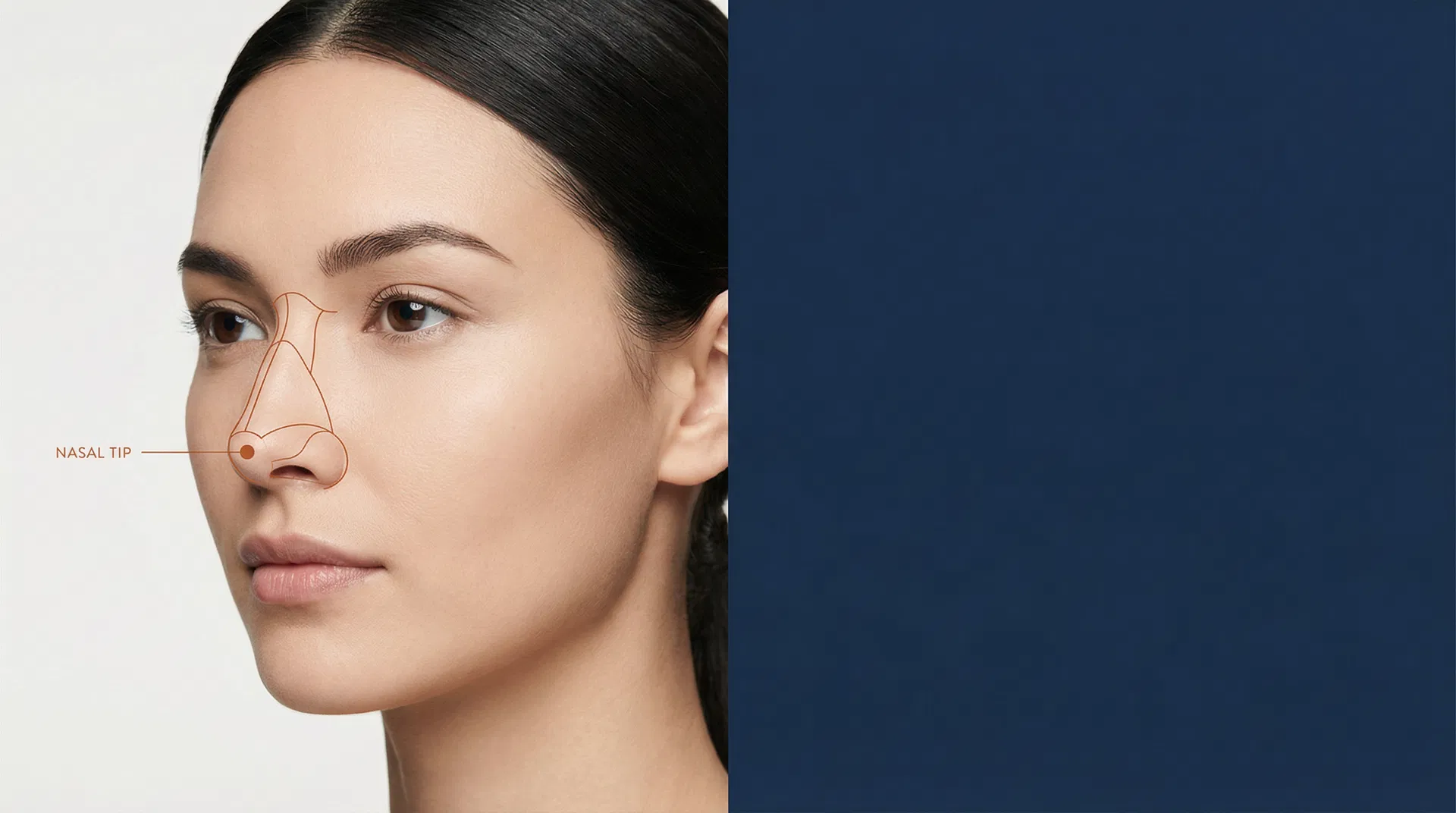
What it is: Reduces how far the nasal tip projects forward from the face. Several techniques exist: cartilage scoring, tongue-in-groove setback, or medial crural overlap.
Why it matters: Addresses a nose that protrudes too prominently. Often combined with tip rotation to achieve a more balanced profile. The technique chosen depends on the degree of projection and the strength of the existing tip support.
Rhinion Hump Reduction
What it is: Removes or reshapes the prominence at the rhinion — the point where the nasal bones meet the upper lateral cartilages, typically the highest point of the dorsal profile.
Why it matters: The most commonly requested change in rhinoplasty. In preservation rhinoplasty, the hump is lowered by letting down the dorsum rather than excising it — preserving the keystone area and reducing the risk of an open roof deformity.
Osteotomy
What it is: Controlled fracture of the nasal bones to narrow the bony vault or close an open roof after hump reduction. Performed with a fine osteotome through small internal incisions.
Why it matters: After removing a dorsal hump, the nasal bones are left separated — creating an 'open roof' that must be closed by infracturing the bones inward. Also used to straighten a crooked bony nose.
Columellar Strut Graft
What it is: A piece of cartilage (usually harvested from the septum) placed between the medial crura of the tip cartilages to create a stable foundation for the tip.
Why it matters: Adds tip support, projection, and definition. Essential in preservation rhinoplasty when tip support has been reduced, and in ethnic rhinoplasty where native tip support may be limited.
Spreader Grafts
What it is: Thin cartilage grafts placed between the upper lateral cartilages and the septum to widen the middle vault and maintain the internal nasal valve angle.
Why it matters: Prevents the pinched, inverted-V deformity that can occur after aggressive hump reduction. Also used to correct a narrow middle vault that contributes to nasal obstruction.
Tip Suture Techniques
What it is: A family of suturing manoeuvres — transdomal, interdomal, and lateral crural mattress sutures — that reshape the tip cartilages without removing tissue.
Why it matters: Allows precise tip refinement with minimal tissue disruption. In preservation rhinoplasty, suture techniques are preferred over excision wherever possible, as they preserve structural integrity and allow for more predictable healing.
Alar Base Reduction
What it is: Removes a small wedge of tissue at the base of the nostrils (alar wedge excision) or at the sill to narrow the base width or reduce flaring.
Why it matters: Addresses nostrils that are too wide or flare excessively. Often performed as a finishing step after tip and bridge work to ensure the base width is proportionate to the new nasal profile.
Septoplasty & Cartilage Harvest
What it is: Straightens a deviated septum and — in the same step — harvests cartilage that can be used as graft material for struts, spreaders, or tip grafts elsewhere in the nose.
Why it matters: The septum is the primary donor site for rhinoplasty grafts. Correcting a deviation improves breathing while simultaneously providing the raw material for structural reconstruction elsewhere in the nose.

Dr. Thomas Buonassisi, MD FRCSC
Board-certified by the American Board of Facial Plastic & Reconstructive Surgery. Over 2,500 rhinoplasty procedures performed since 2008. Specialist in preservation rhinoplasty and complex revision cases.
Technique FAQ
Not sure which technique is right for you?
Tell us your goals and Dr. Buonassisi's team will review your case personally — before you ever step into the clinic.
Strictly confidential · Reviewed by Dr. Buonassisi's team only