Key Takeaways
- 1Preservation rhinoplasty retains the native cartilage and bone structure rather than removing and rebuilding — producing more natural, longer-lasting results.
- 2It is technically more demanding than conventional rhinoplasty and requires specific training; not all surgeons offer it.
- 3The best candidates are patients with a dorsal hump, wide bridge, or those seeking a refined result that does not look 'operated on'.
- 4Recovery is generally faster and swelling resolves more quickly compared to conventional open rhinoplasty.
- 5Preservation rhinoplasty is not suitable for all cases — revision rhinoplasty, severely deviated noses, or cases requiring major structural reconstruction may require a different approach.
What is preservation rhinoplasty?
Preservation rhinoplasty is a modern surgical approach that reshapes the nose by working with the existing cartilage and bone structures — rather than removing them and rebuilding from scratch. The technique was developed in Europe over the past two decades and has been adopted by a growing number of specialist rhinoplasty surgeons worldwide.
In conventional rhinoplasty, the surgeon removes cartilage and bone to achieve the desired shape. In preservation rhinoplasty, the surgeon instead repositions, reshapes, and preserves these structures wherever possible. The result is a nose that retains its natural support, heals more predictably, and tends to look more natural in the long term.
"The goal is not to build a new nose — it is to reveal the best version of the nose that already exists."
How does preservation rhinoplasty work?
The procedure uses a combination of techniques to reshape the nose without removing the structural framework. The key principles are:
- Ligament preservation: The soft tissue ligaments that support the nasal tip are preserved rather than divided, maintaining the natural support structure.
- Dorsal preservation: Instead of removing the dorsal hump (the bump on the bridge), the surgeon pushes it down using controlled osteotomies — preserving the native tissue and producing a smoother, more natural result.
- Cartilage repositioning: Tip cartilages are repositioned and reshaped rather than excised, maintaining structural integrity while achieving the desired refinement.
Dr. Buonassisi frequently combines preservation techniques with piezo ultrasonic instruments — which allow for more precise bone work with less trauma to surrounding tissue.
How does preservation rhinoplasty compare to conventional rhinoplasty?
The two approaches differ fundamentally in philosophy and technique. The table below summarises the key differences:
| Factor | Preservation Rhinoplasty | Conventional Rhinoplasty |
|---|---|---|
| Approach to dorsal hump | Pushes down (preserves tissue) | Removes cartilage and bone |
| Tip technique | Repositions and reshapes | Excises and rebuilds |
| Swelling | Less — tissue trauma is reduced | More — greater tissue disruption |
| Recovery time | Generally faster | Standard (10–14 days visible) |
| Long-term naturalness | Higher — native structure preserved | Depends on technique and volume |
| Complexity | Higher — requires specialist training | Lower — more widely available |
| Best for | Dorsal hump, wide bridge, refinement | Major reconstruction, revision |
Who is a good candidate for preservation rhinoplasty?
Preservation rhinoplasty is not suitable for every patient. The best candidates are those whose goals align with what the technique can achieve:
- Patients with a dorsal hump (bump on the bridge) who want it reduced without the nose looking operated on
- Patients with a wide nasal bridge who want narrowing with minimal swelling and a natural result
- Patients seeking overall refinement who want to preserve the character and ethnicity of their nose
- Patients with good nasal skin (not excessively thick or thin) and adequate cartilage support
When is preservation rhinoplasty not the right choice?
Preservation rhinoplasty is generally not the first choice for revision rhinoplasty (where scar tissue and altered anatomy are present), severely deviated noses requiring major structural correction, or cases where significant structural reconstruction is needed. In these cases, Dr. Buonassisi will recommend the most appropriate technique for your anatomy and goals.
What does recovery from preservation rhinoplasty look like?
Recovery from preservation rhinoplasty is generally faster and more comfortable than conventional rhinoplasty, because less tissue is disrupted during surgery. However, it is still a significant procedure and patients should plan for a full recovery period.
- Days 1–3: Swelling and bruising are present but typically less than conventional rhinoplasty. A splint is worn on the nose.
- Days 7–10: Splint is removed. Most patients are comfortable returning to work and social activities.
- Weeks 2–4: Residual swelling continues to resolve. The nose looks significantly improved.
- Months 3–6: Swelling continues to resolve. The result becomes clearer.
- 12 months: Final result. The nose has fully healed and the result is stable.
At 8 West Clinic, all rhinoplasty patients have access to our recovery programme — including red light therapy, IV therapy, and other amenities — during the early recovery phase. These are included in the procedure fee.
What results can I expect from preservation rhinoplasty?
Preservation rhinoplasty produces results that are consistently described as natural-looking — because the native structure of the nose is preserved rather than rebuilt. Patients who have had preservation rhinoplasty with Dr. Buonassisi typically describe their result as "my nose, but better" rather than a noticeably different nose.
"The most common feedback I receive from preservation rhinoplasty patients is that people notice they look better — but can't identify exactly why. That is the goal."
Results are long-lasting. Because the native cartilage and bone are preserved rather than removed, the structural support of the nose remains intact — reducing the risk of long-term collapse or distortion that can occur when too much tissue is removed.
How do I choose a surgeon for preservation rhinoplasty?
Preservation rhinoplasty is technically more demanding than conventional rhinoplasty and requires specific training. Not all rhinoplasty surgeons offer it. When evaluating surgeons, ask the following questions:
- Have you trained specifically in preservation rhinoplasty techniques? With whom?
- What percentage of your rhinoplasty cases use preservation techniques?
- Can you show me before and after photos of preservation rhinoplasty cases similar to mine?
- How will you decide whether preservation rhinoplasty is the right approach for my anatomy?
Dr. Buonassisi is one of a small number of Canadian surgeons who has trained extensively in preservation rhinoplasty and uses it as a primary technique in appropriate cases. He will assess your anatomy at consultation and recommend the approach most likely to achieve your goals.
Frequently asked questions
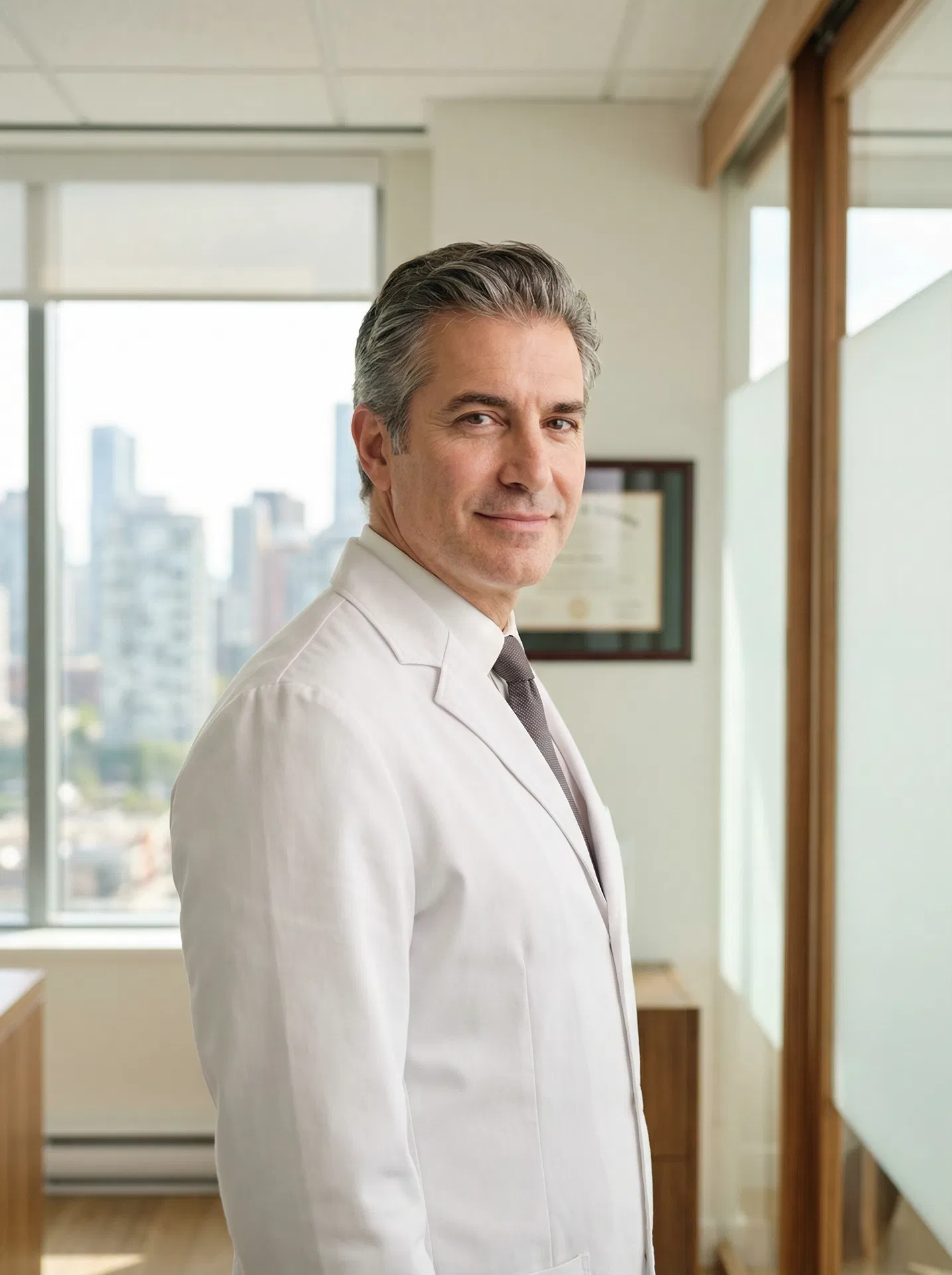
Written by
Dr. Thomas Buonassisi, MD FRCSC ABFPRS
Facial Plastic Surgeon, 8 West Clinic
Dr. Buonassisi is one of Canada's most experienced rhinoplasty specialists, with over 2,500 procedures performed since founding 8 West Clinic in Vancouver in 2004. He is one of a small number of Canadian surgeons who has trained extensively in preservation rhinoplasty and piezo ultrasonic techniques.